

Backstroke Swimming Technique Guide and Tips | Shaw Method
Learn effortless backstroke swimming with the Shaw Method
Backstroke is one of the most graceful and liberating strokes when approached mindfully. With the Shaw Method, backstroke becomes a chance to experience rhythmic movement and full-body integration.
You’ll learn how to improve your body position, arm movement and timing to swim with more confidence, strength and flow – without strain or stress, releasing tension in the spine and neck while building coordination and balance.
We offer backstroke swimming lessons in London, supporting swimmers of all levels to develop confidence and enjoyment in the water.
Benefits of Learning Backstroke with the Shaw Method
Backstroke gives you the opportunity to stop looking down and start looking up. With your face open to the sky and your body supported by the water, breathing becomes more natural and enables the stroke to find effortless flow.
With the Shaw Method , backstroke swimming creates a sense of calm that allows tension to soften and movement to become more fluid. As the body learns to balance on its back, the shoulders, back, core and legs work together in quiet coordination. Strength develops not through force, but through repetition, rhythm and efficient movement.
Whether you’re learning to swim, recovering from injury or refining your technique, backstroke swimming with the Shaw Method encourages confidence through relaxation rather than effort.
Advantages of the Shaw Method
- Supports spinal health – ideal for releasing tension in the neck and back
- Promotes calmness – learn to feel safe and relaxed while floating on your back
- Improves posture and strength – through mindful, integrated movement
- Protects joints – learn to use your body’s natural biomechanics.
Understanding Backstroke with the Shaw Method
Backstroke is perhaps the most unusual of all swimming strokes. You move forward while looking away from where you’re going. The water carries you, the sky becomes your horizon, and progress depends less on effort than on trust.
Unlike other strokes, backstroke invites a different relationship with movement. One that combines alternating arms, a continuous flutter kick, gentle rotation and an easy breathing rhythm into a single flowing whole.
The challenge is not forcing the stroke. It is allowing the body to organise itself around balance.
Streamlined Body Position
- The body should remain as flat and streamlined as possible.
- Important Backstroke Positioning Tips
- Keep hips high near the water surface
- Maintain a neutral head position
- Keep the chin slightly tucked
- Engage the core muscles
- Avoid bending at the waist
The Circle of the Arms
-
-
The arms move continuously, each taking its turn above and below the water.
Entering
The hand slips into the water little finger first, entering in line with the shoulder.
There is no need for force. Think of the hand finding a path rather than creating one.
Holding
Once beneath the surface, the arm begins to gather water.
The elbow softens, the forearm engages and the body works with the movement to create propulsion. Rather than pulling harder, focus on feeling more water.
Releasing
Above the surface, the arm recovers long and relaxed.
The shoulder rotates naturally. The hand remains soft. Recovery is not a pause from the stroke—it is part of the rhythm.
-
A Quiet Kick
The flutter kick provides continuity.
Its purpose is not to create dramatic power but to maintain balance, rhythm and momentum.
The movement begins from the hips, travelling through long legs to relaxed feet. Small, consistent kicks are often more effective than large, forceful ones.
Think less about kicking harder and more about allowing the legs to participate in the journey.
Rotation: The Hidden Partner
Backstroke is rarely as flat as it appears.
Beneath the surface, the body gently rolls from side to side. Hips and shoulders rotate together, creating space for the arms to move freely.
This rotation lengthens the stroke, reduces strain on the shoulders and helps transform effort into efficiency.
Many swimmers try to move their arms through the water.
Skilled swimmers allow their rotation to help move the arms.
Finding Rhythm
Good timing often feels less like coordination and more like music.
As one arm enters the water, the other is completing its pull. The body rotates naturally between them while the kick provides a steady background beat.
When the rhythm is right, the stroke becomes surprisingly calm.
You feel carried rather than driven.
Meeting the Wall
Turns are where flow meets precision.
Competitive swimmers use a backstroke flip turn to maintain momentum through the wall. The process begins long before the turn itself, with an awareness of distance and rhythm.
Approaching the wall, swimmers often count strokes to establish consistency. A smooth rotation onto the stomach leads into a compact tumble, followed by a streamlined push-off and underwater dolphin kicks.
The goal is not simply to turn around.
It is to preserve movement.
To leave the wall with the same ease and connection that brought you there.
The Shaw Method View
Backstroke teaches a valuable lesson.
You do not need to see where you are going to move well.
Balance creates freedom. Rotation creates power. Relaxation creates efficiency.
And often, the swimmer who appears to be doing less is travelling through the water more effectively than the swimmer doing more.
The water responds best not to struggle, but to cooperation.

Common Beginner Mistakes
Sinking The Hips
When the hips drop, the legs drag heavily through the water, forcing the swimmer to work twice as hard to move forward. Usually caused by weak core engagement or poor kick technique. Keeping the chin slightly tucked and pushing the chest gently upward helps restore a flat, horizontal body position.
.
Lifting the Head Too High
A common tendency is to lift the head too far out of the water when breathing. This causes the hips and legs to drop, creating resistance and making the stroke more tiring.
Allow the head to follow the natural rise of the stroke, rather than lifting it independently. A smaller, more integrated movement helps maintain balance and ease.
Bent Knees During Kick
This mistake often turns the kick into a bicycle-like motion that pushes water forward instead of backward. Efficient propulsion must come from the hips with long, relaxed legs and floppy, loose ankles.
Crossing Arms Over the Midline
Entering the water behind the head instead of in line with the shoulders causes the entire torso to snake from side to side and leads to zig-zag swimming. This unnecessary weaving wastes energy and makes it impossible to swim in a straight line down.
Poor Rotation
Flat swimming forces the arms to do all the work from an awkward angle, which pinches the rotator cuff joints over time, can strain shoulders and reduce stroke efficiency. Rotating the body smoothly like a rolling log allows the large back muscles to drive the pulling motion safely.
Lifting the Head
Looking toward the toes instantly causes the hips and legs to drop like an anchor to the bottom of the pool. To keep the body floating high, the back of the head must rest heavily in the water with the eyes focused straight up at the sky or ceiling.
Backststroke Lessons for Adult Beginners in London
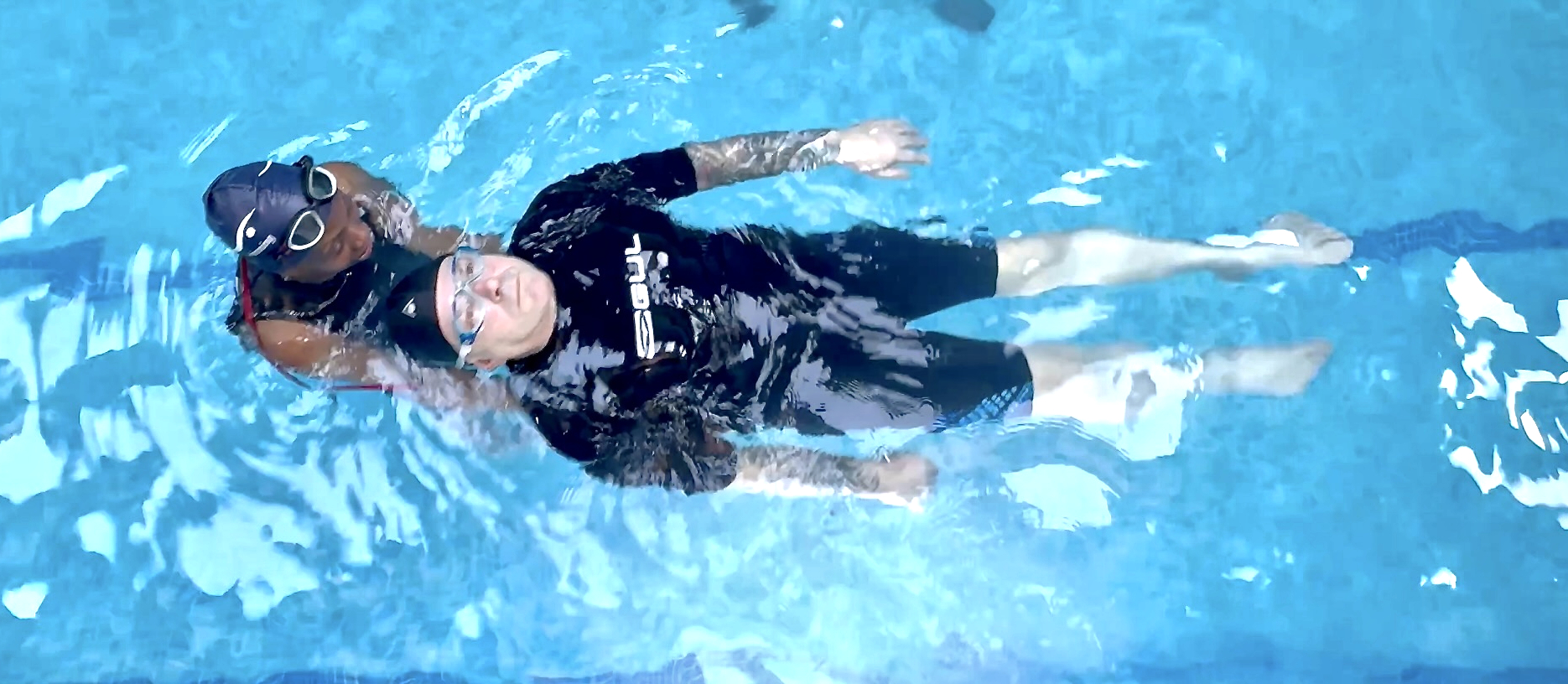
Level 1: Shaw Method Breaststroke Lessons for Adult Beginners in London
Who’s it for?
For adult beginners or those new to the Shaw Method who want to learn the backstroke in a small group setting or a solo lesson.
In our lessons, you’ll learn how to:
In your lesson, you will learn how to:
- Achieve a stable and supported body position on your back
- Develop fluid, well-timed arm and leg movements
- Learn to use gentle body rotation to enhance streamlining
- Discover a continuous, flowing rhythm in your stroke
- Establish a calm, relaxed breathing pattern
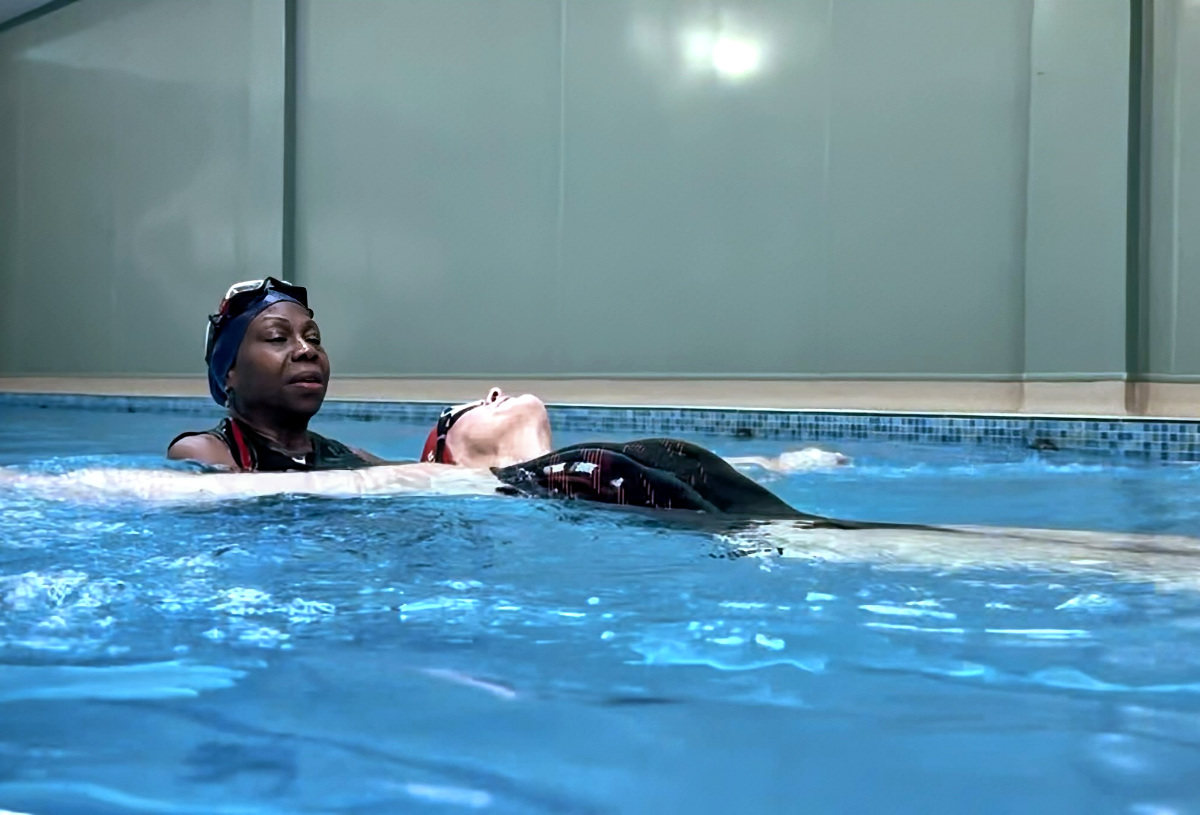
Level 2: Refine Your Breaststroke Technique – Lessons for Improvers in London
Who’s it for?
Returning Shaw Method swimmers and confident backstrokers who want to refine their technique, increase propulsion, and explore deeper body awareness in the water.
In our lessons, you’ll learn how to:
In your lesson, you will learn how to:
-
Improve rhythm, timing, and propulsion
-
Refine your balance and alignment for reduced drag
-
Strengthen the legs and core without overexertion
-
Feel more at ease and confident in the water
Frequently Asked Questions About Backstroke Technique
How do I swim in a straight line if I can't see where I'm going?
Swimming straight begins with consistency, not sight. When both arms move evenly and your body rotates naturally from side to side, you’ll naturally travel straighter. In the pool, use ceiling features as gentle reference points, and over time you’ll develop a feel for direction through rhythm rather than constant correction.
Why do my hips keep sinking?
This is one of the most common experiences in backstroke. Rather than trying to lift your hips, allow your head to relax and trust the water to support you. A long body, soft breathing and gentle core engagement usually create better balance than trying to hold yourself up.
Why does backstroke feel harder than it looks?
Good backstroke looks effortless because efficient swimmers are working with the water rather than against it. Instead of trying to move faster, focus on becoming longer, quieter and more balanced. Speed is usually the result of better organisation, not greater effort.
Should I kick harder to swim faster?
Not usually. In backstroke, the kick is there to support balance and rhythm as much as propulsion. Small, relaxed kicks from the hips are often far more effective than large, powerful ones. When the whole body works together, you don’t need one part to do all the work.