

Butterfly Swimming Stroke – Technique, Timing & Courses for Beginners and Advanced Swimmers
Discover the Joy of Effortless Flight with the Shaw Method
Often seen as the most challenging of the four strokes, the butterfly swimming stroke can also be one of the most dynamic and rhythmic, especially when learned with mindfulness and ease. The Shaw Method teaches butterfly not as a brute-force stroke, but as a smooth, wave-like sequence that feels as good as it looks.
You’ll learn to work with the water’s natural support and the rhythm of your own body to develop a more graceful, sustainable stroke. Yes, you can learn butterfly — whatever your age or athletic ability.
Why Learn Butterfly the Shaw Method Way?
-
Transforms a challenging stroke into an enjoyable, flowing experience
-
Encourages full-body coordination and rhythmic breathing
-
Reduces strain and tension often associated with traditional butterfly
-
Builds strength, spinal mobility, and graceful movement
-
Boosts confidence through patient, step-by-step learning
Understanding the Butterfly Swimming Stroke
The butterfly swimming stroke is often misunderstood as a strength-based stroke. In reality, effective butterfly is built on body organisation, timing, and rhythm, rather than force. When these elements work together, butterfly becomes smoother, lighter, and far less tiring.
Body Position and Balance
A good butterfly swimming stroke begins with a long, balanced body position. Rather than lifting the chest or pressing the head down, the body stays connected and buoyant, moving forward with the support of the water. The hips remain close to the surface, allowing the stroke to flow without unnecessary drag.
In the Shaw Method, the focus is on length and balance, not tension. When the body is organised well, the stroke feels supported rather than heavy.
Head Position and Movement
Head position plays a crucial role in butterfly technique. The head is not held rigid or forced; instead, it moves naturally as part of the body’s overall wave-like motion. Small, well-timed head movements help organise the rest of the body without disrupting balance.
Breathing happens with minimal lift, allowing the swimmer to maintain rhythm and forward momentum rather than breaking the flow of the stroke.
Wave-Like Body Movement
Butterfly is driven by a smooth, continuous body movement rather than isolated arm or leg actions. This wave-like motion travels through the body in a coordinated way, helping to generate propulsion with less effort.
Rather than exaggerating the undulation, the Shaw Method encourages economy of movement — enough motion to support the stroke, without strain or collapse.
Timing and Coordination
What makes butterfly feel difficult for many swimmers is poor timing. When the kick, arms, and breath are out of sync, the stroke quickly becomes exhausting.
By learning to coordinate these elements — body movement first, then kick, arms, and breathing — the butterfly swimming stroke becomes more efficient and sustainable. When the timing is right, the stroke feels rhythmic and surprisingly light.
A Sustainable Approach to Butterfly
When taught with awareness and progression, the butterfly swimming stroke can be both athletic and therapeutic. Many swimmers find that improved butterfly technique supports spinal mobility, coordination, and whole-body integration.
The Shaw Method approaches butterfly as a stroke to be felt and understood, not forced — allowing swimmers to develop confidence, control, and enjoyment over time.
Step-by-Step Guide to the Butterfly Swimming Stroke
The butterfly swimming stroke works best when it is approached as a connected, rhythmic sequence rather than a set of isolated movements. Each phase supports the next, creating a smooth and sustainable flow through the water.
1. Body Position and Streamline
Begin in a long, balanced position in the water. Your body should feel relaxed and supported, with the head looking slightly down and the spine lengthened. Rather than holding tension, allow the water to carry you forward as one connected line.
A stable, streamlined body position is the foundation of an efficient butterfly swimming stroke.
2. First Dolphin Kick – Initiating the Wave
The movement starts from the centre of the body, not the legs alone. A gentle wave passes through the chest and hips, followed by the first dolphin kick. This kick is driven from the hips, with soft knees and relaxed feet.
The purpose of this first kick is not power, but rhythm — it sets the timing for the rest of the stroke.
3. Arm Catch and Pull
Both arms enter the water together, slightly wider than the shoulders. From here, the arms begin the catch, pressing the water back in a smooth, controlled motion. Elbows stay relatively high, allowing the hands and forearms to work effectively against the water.
In the Shaw Method, the arm pull supports forward movement without excessive force, working in harmony with the body wave.
4. Breath and Arm Recovery
As the arms complete the pull, the chest lifts subtly and the head follows naturally. The breath is taken forward with minimal lift, avoiding disruption to balance or rhythm.
The arms then recover together over the water in a relaxed, unforced way. Keeping the chin low and the movement compact helps maintain flow and reduces strain.
5. Second Dolphin Kick – Supporting Forward Drive
As the arms recover, a second dolphin kick follows. This kick helps stabilise the body, supports forward momentum, and prepares the swimmer to return smoothly to streamline.
When timed well, this second kick feels supportive rather than effortful.
6. Return to Streamline
The arms re-enter the water together, the head returns gently to a neutral position, and the body lengthens once more into a balanced streamline. From here, the sequence begins again with continuity and rhythm.
This moment of reorganisation is key to sustaining the butterfly swimming stroke over multiple lengths.
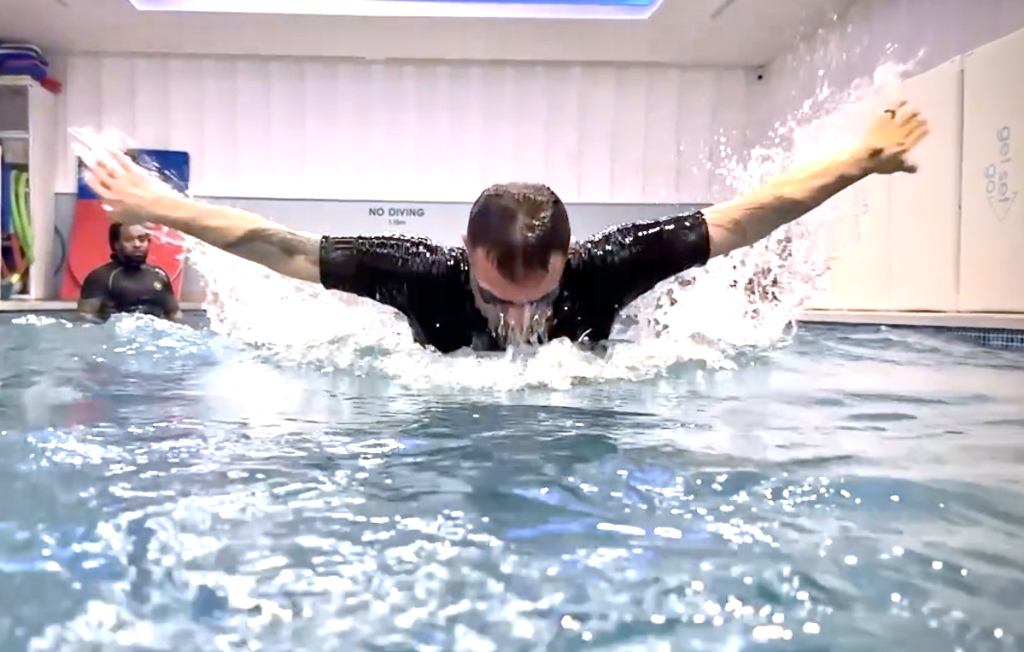
Level 1: Butterfly Stroke Course for Adult Beginners in London
Who’s it for?
This course is ideal for adult beginners in London who:
- Are comfortable with full body submersion
- Can swim at least 25m of any stroke
- Want to learn butterfly from scratch or refine their existing technique
What to Expect
With the Shaw Method, you’ll discover that butterfly swimming is not about brute strength,
but about rhythm, breath, and grace. Level 1 guides you through each element of the stroke,
breaking it into manageable, flowing phases supported by visual demonstrations and mindful movement.
By the end of the course, you’ll:
- Learn to coordinate breathing, arm recovery, and body movement with ease
- Develop a smooth, wave-like butterfly sequence: kick, catch, pull, recover
- Experience a lighter, more energy-efficient stroke that feels good to swim

Level 2: Improve Your Butterfly Stroke – Course for Advanced Swimmers
Who’s it for?
Level 2 is designed for advanced adult swimmers in London who have completed the Shaw Method
butterfly progression, or who already swim butterfly and want to reduce strain and improve efficiency.
What to Expect
This course builds on the foundational butterfly sequence, with a focus on timing, rhythm,
and a deeper understanding of how the body moves through water. You’ll refine each phase of the stroke
to enhance flow, reduce effort, and sustain the stroke over longer distances.
You’ll also explore how the butterfly swimming stroke can support spinal mobility and core strength,
making it especially beneficial for swimmers experiencing back stiffness or tension.
By the end of the course, you’ll:
- Develop a lighter, slower arm recovery with improved timing and coordination
- Create a sustainable rhythm that integrates kick, arms, and breathing
- Swim butterfly with greater confidence, fluidity, and freedom
Frequently Asked Questions About Learning the Butterfly Swimming Stroke
Is the butterfly swimming stroke hard to learn?
Butterfly has a reputation for being difficult, but it is often taught in a way that makes it feel harder than it needs to be.
When the butterfly swimming stroke is broken down step by step and built around rhythm and body movement, it becomes far more
approachable — and often enjoyable — to learn.
Can adults learn the butterfly swimming stroke?
Yes. Adults can learn the butterfly swimming stroke at any age. With the right approach, many adult swimmers find that butterfly improves coordination, body awareness, and overall flow in the water rather than feeling overwhelming or exhausting.
Do I need to be very fit to learn butterfly swimming?
You don’t need to be extremely fit to start learning butterfly. While fitness helps, technique and timing matter far more.
An efficient butterfly swimming stroke actually builds strength and endurance gradually, without excessive strain.
Is the butterfly swimming stroke harder than freestyle or breaststroke?
Butterfly is more technical than freestyle or breaststroke, but not necessarily harder. It simply requires better timing and coordination. Once the rhythm of the stroke is understood, butterfly can feel surprisingly smooth and light.
What is the best way to learn the butterfly swimming stroke?
The most effective way to learn butterfly is in small, connected pieces — starting with body movement, then adding kick, arm action, and breathing. Guided instruction helps you develop a smooth, energy-efficient butterfly swimming stroke without picking up unnecessary tension or bad habits.
Why do people get tired so quickly when swimming butterfly?
Fatigue usually comes from poor timing, overusing the arms, or lifting the head too much to breathe. When the body, kick, arms, and breathing work together, the butterfly swimming stroke becomes far less exhausting and much more sustainable.
What are common mistakes in the butterfly swimming stroke?
Common mistakes include lifting the head too high when breathing, kicking from the knees instead of the hips, rushing the arm recovery, and trying to muscle the stroke. Most of these issues come from focusing on effort rather than rhythm and coordination.
How long does it take to learn the butterfly swimming stroke?
This depends on your starting point and how you learn. Many swimmers can begin swimming short, comfortable butterfly lengths within a few weeks when the focus is on technique, rhythm, and ease rather than strength or speed.